
You’ve been there. Someone suggests getting together - a dinner, a weekend trip, a team offsite - and everyone’s excited. Then someone asks the question that quietly kills the plan: “What time works for you?”
What follows is a slow-motion disaster of good intentions. Texts pile up in a group chat. Someone replies with three possible dates. Someone else can do one of those, but only in the afternoon. A third person doesn’t respond for days because they can’t muster the energy to try to convey the messiness of their schedule. Everybody else has muted the group chat because they can’t take the notifications anymore. By the time you’ve heard back from everyone, the original options don’t work anymore and you’re starting over. Or worse - you just give up and say “we’ll figure it out later,” which is code for “this is never going to happen.”
We can land a rocket, converse with our computers, and build self-driving cars, but we can’t figure out when to get together for a beer? We can do better.
The spreadsheet hack
Years ago, I was at work trying to coordinate a few applicants and an interview panel. I was collecting everyone’s availability over email, but keeping it all straight and trying to actually pin down the best times was a nightmare. So I did what I always do - I opened up Google Sheets and tried to lay it out and visualize it.
And it worked. Not because it was fancy, but because it made the problem visible. Instead of trying to hold everyone’s constraints in my head while parsing a wall of email replies, I could just look at the sheet and see where the colors aligned.
I looked around for an app that did this properly. There were a couple of options, but they all had problems - one-way book-a-time-on-my-calendar scheduling, cluttered with ads, locked behind subscriptions, confusing interfaces, very limiting constraints, or they tried to “solve” scheduling by syncing calendars, which fundamentally misunderstands how people actually manage their time.
My spreadsheet hack kind of worked, but we are wired to think of schedules in two dimensions: columns of weekdays and rows of hours or full days. But comparing multiple two-dimensional grids is tricky. I managed to make it work, but I realized what I needed was a streamlined way to layer each person’s two-dimensional schedule on top of each other to see where the overlaps were. Kind of like overhead projector transparencies (if you were born after about 1985, ask your parents).
I filed it away at the top of my list of side projects to get around to someday.
Why calendar sync doesn’t work
It seems like it should be simple: just connect everyone’s calendars and find the open slots. But calendars are messy. An empty block on your calendar doesn’t mean you’re available - maybe you just haven’t added that thing yet or maybe you don’t put every commitment on your calendar. On the flip side, a busy block doesn’t mean you’re not available - maybe you’d move it for the right person or that time block is just a placeholder that could go anywhere. Some people schedule everything down to the minute. Others barely use their calendar at all.
And then there are the preferences that never show up on any calendar. You’d prefer Tuesday for the strategy discussion because you have a meeting Wednesday that would be more effective if that conversation happened first. You could do that coffee chat Friday, but you’d rather not because you’ll be exhausted from travel. Next Saturday works for a barbecue, but only if it’s after 4pm because your kids have tournaments.
No calendar integration can capture this. Scheduling isn’t a data problem - it’s a human problem. The only person who knows your real availability, preferences, and constraints is you. What’s needed is a simple way to express them and a clear way to compare them across a group.
What ClearDate does
ClearDate gives you a calendar-like view of possible dates and times that’s editable like a simple spreadsheet (with some cool superpowers). Each participant colors in their availability using four intuitive options:
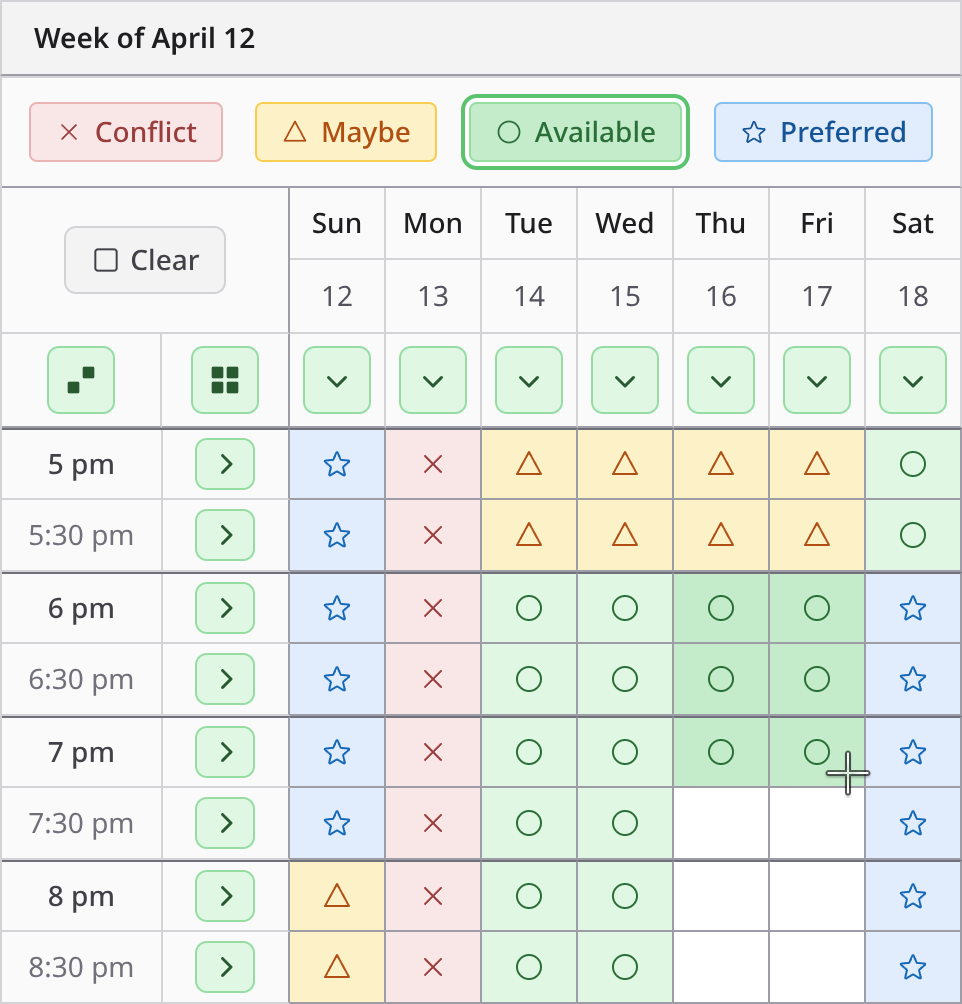
That’s it. No account linking, no calendar permissions, no complicated setup. Just look at the dates, think through your schedule, and color in the boxes.
Click here to try a demo of filling in the availability calendar.
As people respond, ClearDate overlays all of the responses (including the host’s) into a single view that makes it immediately obvious which options work best for the group.
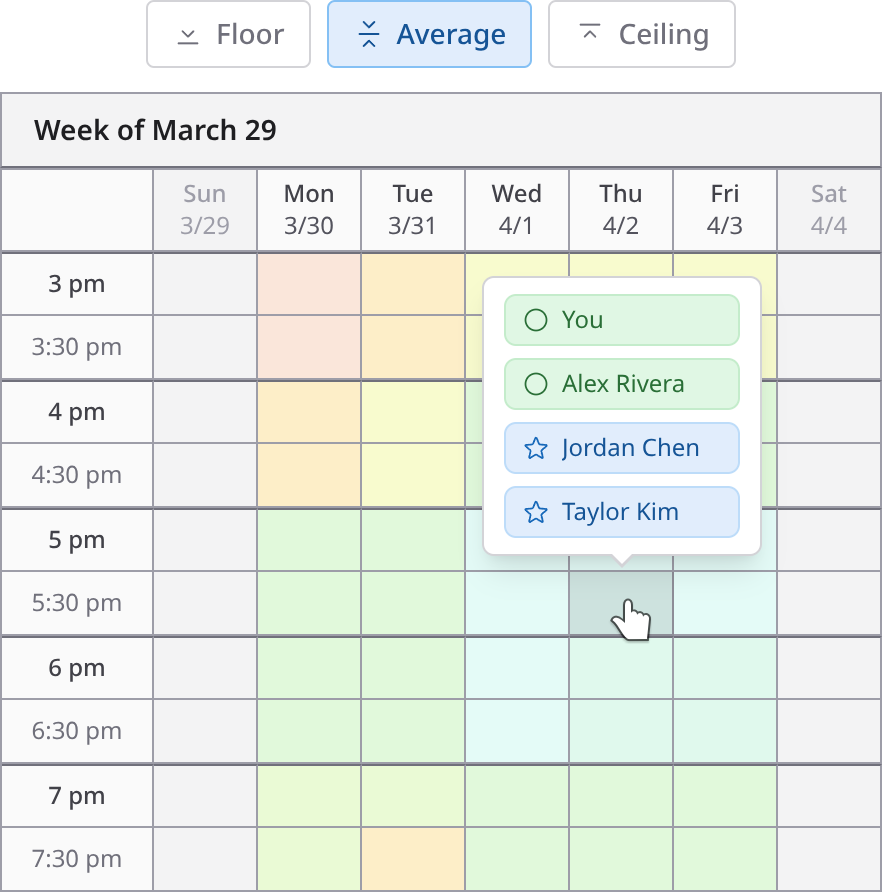
The host can see at a glance where the greens and blues cluster, where the conflicts are, and which dates have the most flexibility. Then they pick the best option and send out the details.
Click here to try a demo of comparing people's availability.
Why I built it this way
I started building ClearDate years ago. I could have shipped something faster, but I wanted to get it right. I wanted it to feel good to use: clean, fast, and intuitive. I didn’t want to rely on ads or require a monthly subscription just to schedule a dinner with friends.
Instead, ClearDate uses a simple credit model. You get free credits when you sign up, and credits are inexpensive to purchase if you need more. No subscriptions required, no ads, no selling your data. Just a tool that does one thing well.
I was heavily influenced by products like Linear that prove software can be both powerful and beautiful - that craft and attention to detail aren’t luxuries, they’re what make a product worth using. And just because other companies have built products to address a problem, doesn’t mean they’ve succeeded in solving it to the point where people actually enjoy using it.
Where things stand
I launched ClearDate this month. The product is live and it works well, but I have a long list of features and improvements that I’m excited to work on, and the feedback from early users will shape what comes next.
If you’ve ever had a get-together fall through because the scheduling just never came together, I’d love for you to give it a try (click here to try a demo). It’s free to start, and I genuinely want to hear what you think.
And if you want to stay in the loop as ClearDate grows, you can subscribe to the newsletter (scroll down to the bottom of the page). No spam, just occasional updates.
Here’s to fewer missed chances and more time with good people.